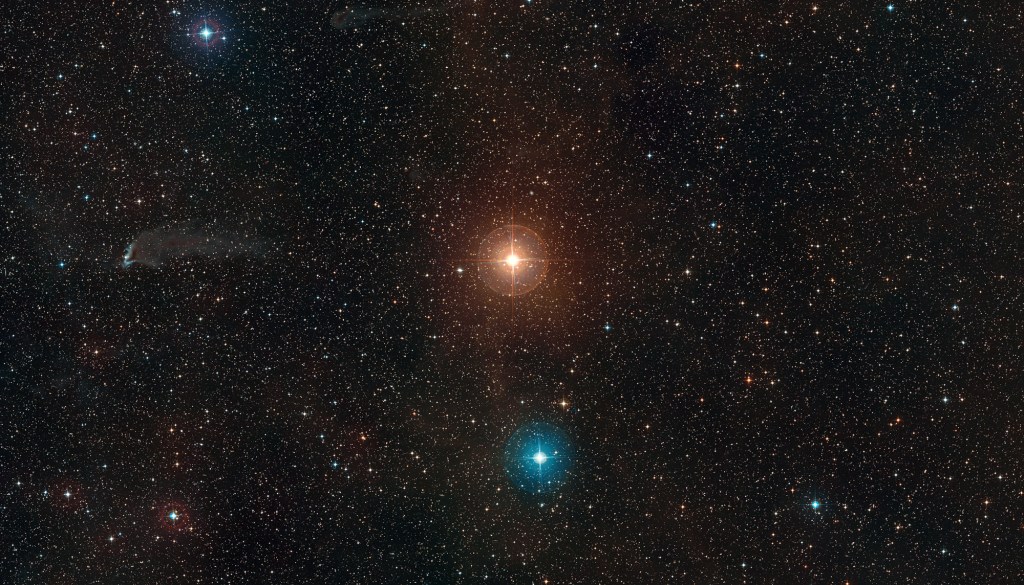
Astronomers have discovered an exceedingly old star at the edge of our galaxy that seems to have formed only a few million years after the Big Bang – and what they are learning from it could affect their understanding of the birth of the universe.
In a study published last week, researchers found the star during an astronomical survey of the southern sky with a technique called narrowband photometry, which measures the brightness of distant stars in different wavelengths of light and can reveal stars that have low levels of heavy elements.
They then studied the star – known by its survey number as SPLUS J210428.01−004934.2, or SPLUS J2104−0049 for short – with high-resolution spectroscopy to determine its chemical makeup.
They’ve now determined it is one of a very few “ultra metal-poor” stars, or UMP, signifying that it is one of the oldest stars ever seen.
“They are very rare – we only know of about 35 of them after looking for decades,” said astronomer Vinicius Placco of the National Science Foundation’s astronomical research laboratory NOIRLab in Tucson, Arizona.
More: Astronomers are still looking for the elusive ‘Planet 9’ (nbcnews.com)
 The Somnium Project
Leave a comment